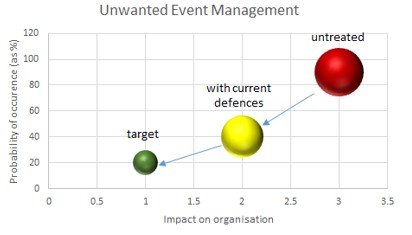
The overall objective of the EBCA system is to assist management to
attain optimal loss prevention equilibrium, i.e. balance the spend on loss
prevention effort and the losses that will occur if nothing is done.
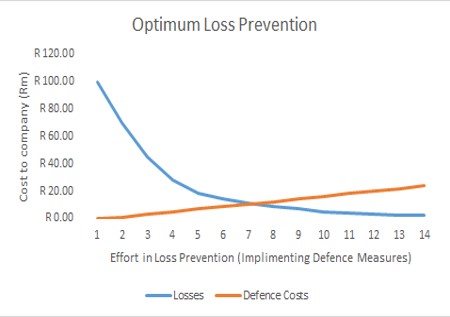
Any endeavour by a business or organisation must keep its effect on
the bottom line in mind. If no effort is put into the prevention of unwanted events,
then the probability of high and catastrophic losses becomes a reality. If
resources are made available for defence measures, then the potential for
losses will decrease. The more resources the bigger the reduction in losses.
Unfortunately, this will also be subject to the law of diminishing returns. A
point will be reached where a high cost for defences will only result in a
small reduction in losses and can eventually be more expensive than the actual
losses being prevented. The ideal expenditure on defences will be where the
cost of defence measures reaches an equilibrium with the losses being
prevented.
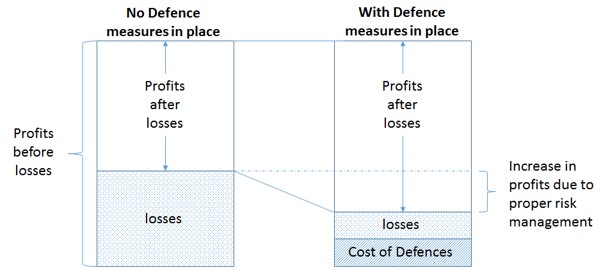
The allocation of resources to defence
measures will have a direct impact on profits although unplanned events may
have catastrophic consequences on the existence and future of the business. The
net effect of unplanned losses is financed directly out of profits. Many a
company has closed its doors by ignoring risk principles.
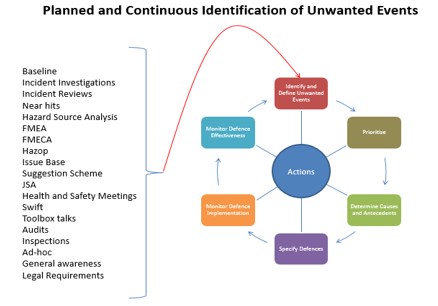
Detail record of Base line risk assessments with full
investigation of processes, energy hazards, hazards, workplace risks, unwanted
event including full causal analysis.
Issue Base Risk Assessment Data Store
Keep a detailed list of all potentially unwanted events
identified during the different types of risk assessments and other recordings.
Unwanted events must be prioritised and the high rated events should be
analysed in fine detail.
Unwanted Events Data Store. All Risk Assessment and
assessment types must be conducted to identify and describe the unwanted event
that must be prevented from materialising. The Unwanted Events Data Store is a
central and key entity in the entire Risk Management System.
Swift Analyses Data Store.
Hazard Source Analysis Data Store.
FMEA'S Data Store.
FMECA Data Store.
Drop-down
list to differentiate between Cause, Defence or Consequence.
Drop-down
list for Defence Measure Categories .
Opportunities
Data Store.
List of all Causes / Pre-Cursors / Antecedents that may contribute to unwanted events, incidents or potential incidents.
Data Store 'Class of Places' available as drop-down list.
Data Store 'Defence Measure Status' available as drop-down list.
Data Store 'Event Categories' available as drop-down list.
Data Store 'Exposure Types' available as drop-down list.
Data Store 'Job Observation Types' available as drop-down list.
Group hazards and causes under specific perils.
Process Area Data Stores.
JSA Data Store.
Dedicated space to keep Details of all measures that may act as defences / controls
against possible causes that will result in a loss incident.
Drop-down
list for Defence Measure Types.
List of all activities of persons, org structures, departments etc.
Data Store
'Boolean Gates' available as drop-down list. Boolean gates can be used to calculate probabilities using Boolean algebra.
Data Store 'Consequence Types' available as drop-down list.
Data Store 'Electrical Classifications' available as drop-down list.
Unwanted Event Names.
Details
of all hazards and potential hazards.
Data Store 'Loss Classifications' available as drop-down list.
Data Store 'Permit Categories' available as drop-down list.
Data Store 'Risk Categories' available as drop-down list.
Certain work requires that it is only done when a permit has been issued. This data
store keep track of all permits approved and issued.
Drop-down list for Deviation Types.
Data Store 'Antecedent Types' available as drop-down list
List of Chemical Families.
Data Store 'Defence Measure Qualities' available as drop-down list.
Record of All Energy Sources.
Data Store 'Exposure Severities' available as drop-down list.
Data Store 'Job Observation Reasons' available as drop-down list.
Data Store 'Loss Severity Potential' available as drop-down list.
Keep a record of all applicable processes in the organisation.